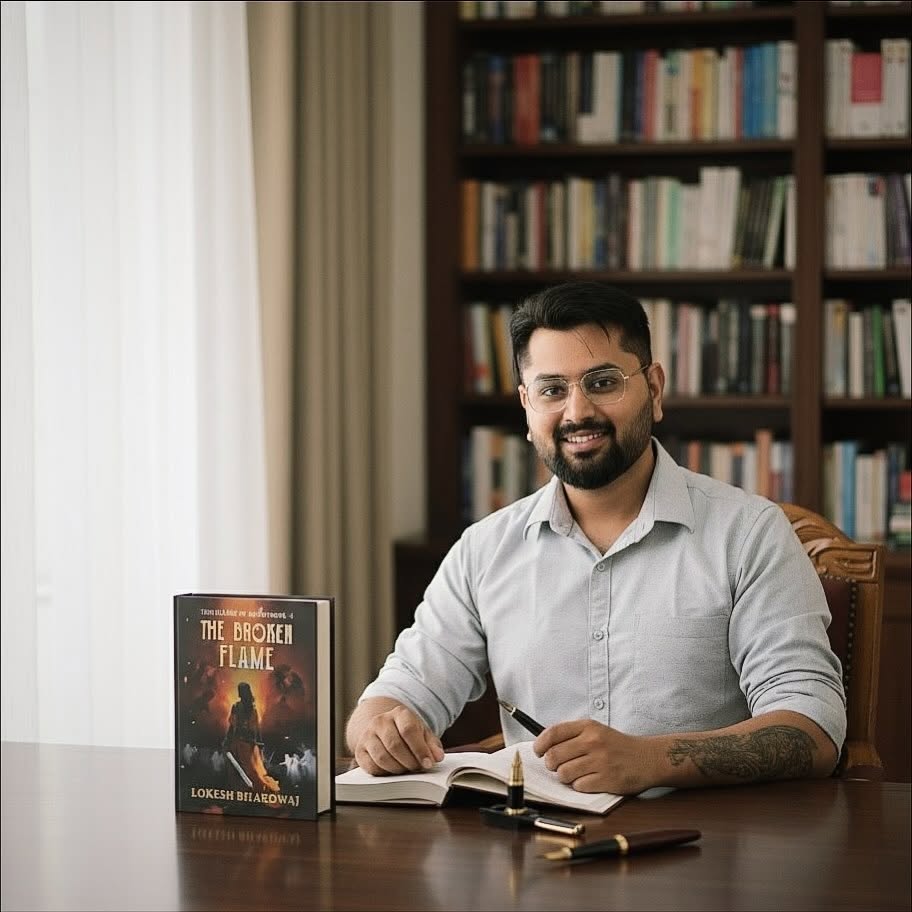
Indian author Lokesh Bhardwaj has steadily emerged as a distinctive voice in contemporary literature through his thoughtful blend of mythology, philosophy, and emotionally engaging storytelling. Best known for creating The Flames of Aryavarta trilogy, he has built a reputation for writing stories that explore identity, morality, destiny, leadership, and spiritual growth while remaining deeply rooted in Indian cultural traditions.
Beyond fiction, Lokesh Bhardwaj is an engineer, educator, poet, and academic whose diverse experiences have shaped his approach to storytelling. In this exclusive interview, he shares insights into his creative journey, inspirations, writing process, literary influences, and future projects.
Q1. For readers discovering you for the first time, could you introduce yourself?
Lokesh Bhardwaj:
I am an Indian author passionate about writing mythological and philosophical fiction. Alongside my literary work, I have an academic background in Electrical Engineering and currently work in higher education. Writing has always been more than a profession for me—it is a way of exploring human emotions, ethics, spirituality, and the timeless questions that shape our lives.
Through my books, I hope to create stories that entertain readers while encouraging them to reflect on their own beliefs, choices, and purpose.
Q2. You come from an engineering background. How did writing become such an important part of your life?
Lokesh Bhardwaj:
My interest in writing began long before engineering. During my school years, I regularly wrote poems, essays, and short stories. Literature fascinated me because it allowed me to express ideas that could not always be explained through facts or formulas.
Engineering strengthened my logical thinking, but writing gave me a creative space to explore imagination and philosophy. Rather than seeing these two fields as different, I believe they complement each other. Engineering teaches structure and discipline, while literature allows freedom of thought.
Q3. Growing up in Haridwar, did your surroundings influence your writing?
Lokesh Bhardwaj:
Absolutely. Haridwar is a city where spirituality and tradition are part of everyday life. Listening to religious discourses, observing cultural festivals, and hearing mythological stories from an early age naturally shaped my imagination.
My grandfather narrated scriptures and discussed philosophical concepts, which introduced me to ideas about duty, morality, consciousness, and the nature of existence. Those conversations stayed with me and eventually found their way into my novels.
Q4. Why did you choose mythological fiction instead of historical fiction or fantasy?
Lokesh Bhardwaj:
Mythology offers extraordinary depth because it speaks about universal human experiences. While historical fiction often focuses on documented events and fantasy builds entirely fictional worlds, mythology provides symbolic frameworks that remain relevant across generations.
I wanted to create original stories inspired by Indian philosophical traditions rather than simply retelling ancient epics. My aim has always been to build fictional worlds that feel timeless while encouraging readers to think about leadership, responsibility, sacrifice, and personal transformation.
Q5. Tell us about The Flames of Aryavarta. What inspired the trilogy?
Lokesh Bhardwaj:
The idea developed over several years. I wanted to write a large-scale narrative that combined mythology, politics, philosophy, and emotional storytelling.
The world of Aryavarta allowed me to explore conflicts that exist in every era—power and justice, destiny and free will, ambition and compassion. Rather than presenting simple heroes and villains, I wanted every character to face meaningful moral choices.
The trilogy is ultimately about transformation. Every major character changes through difficult experiences, and those journeys are just as important as the larger political conflicts.
Q6. The Broken Flame introduces readers to Aryavarta. What can readers expect from the first book?
Lokesh Bhardwaj:
The first novel lays the foundation of the entire series. Readers are introduced to a civilization facing political unrest, ideological divisions, and personal struggles.
At its heart, the story explores rebellion, loyalty, destiny, leadership, and sacrifice. While the world contains mythological symbolism, the emotions experienced by the characters are deeply human and relatable.
Q7. How does The Forged Flame expand the story?
Lokesh Bhardwaj:
The second book broadens both the narrative and the emotional scope of the series. Political tensions become more complex, relationships evolve, and philosophical questions become even more significant.
Characters who once believed they understood their purpose are forced to reconsider everything they value. Readers also gain a deeper understanding of the mythology and history surrounding Aryavarta.
Q8. Without revealing spoilers, what can readers expect from the final installment?
Lokesh Bhardwaj:
The concluding novel is intended to bring together every major storyline developed throughout the trilogy. Readers can expect emotional resolutions, difficult decisions, unexpected revelations, and philosophical conclusions that connect back to the beginning of the journey.
My goal is to provide an ending that feels meaningful rather than merely dramatic.
Q9. Your books often discuss destiny and free will. Why do these themes interest you?
Lokesh Bhardwaj:
These questions have fascinated humanity for centuries.
Do we shape our destiny through our choices?
Or are our lives guided by forces beyond our control?
Literature provides a wonderful space to explore these ideas without offering simplistic answers. Different characters respond differently to the same circumstances, allowing readers to develop their own interpretations.
Q10. Your writing contains strong philosophical elements. How do you ensure the story remains engaging?
Lokesh Bhardwaj:
Philosophy should naturally emerge through characters and events rather than feeling like a lecture.
Readers connect with emotions first. If the characters feel authentic, philosophical questions arise organically from their struggles. I always try to maintain a balance between intellectual depth and engaging storytelling.
Q11. Alongside English fiction, you have written the Hindi novel Kamra Number 13. How was that experience different?
Lokesh Bhardwaj:
Writing in Hindi allowed me to express emotions with a different rhythm and cultural nuance. Kamra Number 13 focuses more on psychological complexity and interpersonal relationships.
Although the language changes, my interest in exploring human nature remains the same.
Q12. You also write poetry under the pen name “Avyakta.” Why use a separate identity?
Lokesh Bhardwaj:
Poetry occupies a different creative space. My novels require planning, structure, and long-term development, whereas poetry often captures a single emotion or moment of reflection.
The name “Avyakta” represents thoughts and emotions that cannot always be fully expressed through ordinary language.
Q13. Who are your biggest literary influences?
Lokesh Bhardwaj:
I have always admired writers who combine strong storytelling with philosophical depth. Indian mythology, classical literature, spiritual texts, and modern fiction have all influenced my perspective.
Rather than following a single author, I draw inspiration from multiple traditions and genres.
Q14. How does your academic career influence your creative work?
Lokesh Bhardwaj:
Teaching encourages clarity of thought and continuous learning. Interacting with students keeps me intellectually active, while research develops discipline and patience.
These qualities are equally valuable in writing novels, where consistency and careful planning are essential.
Q15. What advice would you give aspiring writers?
Lokesh Bhardwaj:
Read widely across different genres.
Write regularly, even when inspiration feels distant.
Be patient with your growth.
Most importantly, write stories that genuinely matter to you rather than trying to imitate current trends. Authenticity creates lasting literature.
Q16. What message would you like readers to take away from your books?
Lokesh Bhardwaj:
Every individual faces moments of uncertainty, conflict, and self-discovery.
If my stories encourage readers to think more deeply about courage, compassion, responsibility, and the choices they make, then I believe they have fulfilled their purpose.
Stories have the power not only to entertain but also to inspire reflection, empathy, and personal growth.
Quick Profile: Lokesh Bhardwaj
Profession: Author, Poet, Academic
Genres: Mythological Fiction, Philosophical Fiction, Hindi Literature
Known For: The Flames of Aryavarta Trilogy
Hindi Novel: Kamra Number 13
Poetry Pen Name: Avyakta
Education: B.Tech (Electrical Engineering), M.Tech (Power Systems)
Nationality: Indian
Final Thoughts
Lokesh Bhardwaj’s literary journey demonstrates how mythology and philosophy can be reimagined for modern readers without losing their cultural depth. Through The Flames of Aryavarta, his Hindi fiction, and his poetry, he continues to explore questions that remain relevant across generations—identity, morality, leadership, sacrifice, and the search for meaning.
As readers increasingly seek stories that combine imagination with thoughtful reflection, Lokesh Bhardwaj’s work offers a distinctive voice in contemporary Indian literature, bridging ancient wisdom with modern storytelling.